他の

How ADAS Camera Lenses Improve Driving Safety

May 29, 2026

Advanced Driver Assistance Systems, commonly known as ADAS, are becoming an important part of modern vehicle safety. These systems help drivers detect road conditions, monitor surrounding objects, identify potential risks, and improve overall driving awareness.

In many ADAS applications, cameras play a key role in collecting visual information. However, the image quality of a camera system does not depend only on the image sensor. The camera lens is the first optical component that captures light and forms the image before it reaches the sensor.

A suitable ADAS camera lens can help improve field of view, image clarity, distortion control, low-light performance, and long-term stability. These factors are closely related to how well a camera module can support driving safety functions.

What Is an ADAS Camera Lens?

An ADAS camera lens is an optical lens used in automotive camera modules for advanced driver assistance applications. It helps capture visual information around the vehicle and delivers the image to the sensor for further processing by the system.

ADAS camera lenses can be used in different automotive camera applications, including:

  • Front view cameras
  • Rear view cameras
  • Surround view cameras
  • Driver Monitoring Systems
  • Occupant Monitoring Systems
  • Camera Monitor Systems
  • Parking assistance cameras
  • Lane departure warning systems
  • Traffic sign recognition systems

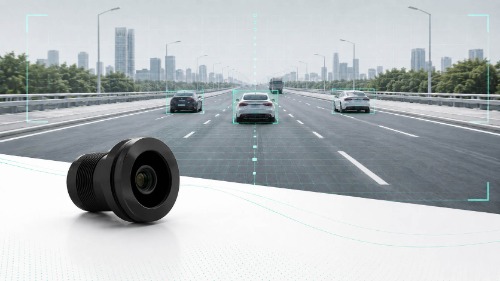
Different ADAS applications require different lens designs. For example, a front view camera may require long-distance clarity and low distortion, while a surround view camera usually requires a wider field of view and stable edge image quality.

ADAS camera lens for automotive driving safety

Why Camera Lenses Matter in ADAS Systems

ADAS systems rely on clear and stable image input to recognize road conditions, vehicles, pedestrians, lane markings, traffic signs, and obstacles. If the lens cannot provide suitable optical performance, the sensor may not receive accurate image information.

The camera lens affects several key imaging factors:

  • Field of view
  • Image clarity
  • Distortion control
  • Resolution matching
  • Low-light performance
  • Environmental reliability
  • Mechanical structure compatibility

A well-designed automotive camera lens helps the camera module capture more reliable image data, which can support safer and more stable ADAS performance.

Wider Field of View Helps Capture More Road Information

Field of view is one of the most important factors in ADAS camera lens selection. A wider field of view allows the camera to capture more surrounding information, which is useful for applications such as rear view cameras, surround view systems, parking assistance, and side view monitoring.

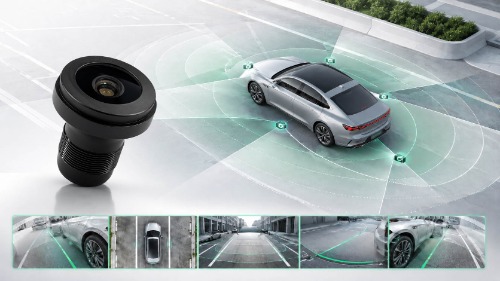
For example, a rear view camera lens needs to cover the area behind the vehicle to help the driver observe obstacles during reversing. A surround view camera lens needs to capture a wide area around the vehicle to support a 360-degree view.

However, a wider field of view is not always better by itself. It should be balanced with distortion control, image clarity, sensor size, and the actual application requirements. For ADAS camera modules, lens selection should consider both optical performance and system-level imaging needs.

Low Distortion Supports More Accurate Image Recognition

Distortion control is especially important for ADAS camera lenses. In automotive camera applications, image distortion can affect how objects, road lines, and surrounding environments appear in the image.

For applications such as lane recognition, object detection, parking assistance, and surround view systems, low distortion helps maintain a more accurate image structure. This is particularly important near the edge of the image, where wide-angle lenses may produce more visible distortion.

A low distortion ADAS camera lens can help improve image consistency and make the captured scene closer to the actual environment. This is valuable for systems that rely on image recognition and visual analysis.

Low distortion automotive camera lens for ADAS systems

High Resolution Lens Matching Improves Object Detection

Many automotive camera modules now use 2MP, 5MP, 8MP, or even higher-resolution sensors. However, a high-resolution sensor also requires a lens with matching optical performance.

If the lens resolution is not sufficient, the sensor may not fully deliver its image quality potential. This can result in reduced image sharpness, lower detail recognition, and weaker performance in object detection.

When choosing an ADAS camera lens, it is important to evaluate whether the lens can match the sensor size, resolution, image circle, and field of view requirements. A suitable lens helps the camera module capture clearer details, which can support better recognition of vehicles, pedestrians, road markings, and other objects.

Stable Imaging in Different Driving Conditions

Vehicles operate in many different environments. ADAS cameras may need to work in daylight, nighttime, rainy weather, tunnels, low-light environments, and backlight conditions. These changing conditions place higher requirements on the optical performance of automotive camera lenses.

Depending on the project requirements, lens design may need to consider:

  • Low-light imaging
  • IR compatibility
  • Anti-glare performance
  • Optical coating
  • Temperature changes
  • Waterproof and dustproof requirements
  • Vibration resistance

Stable imaging performance helps the camera module provide more consistent visual information under different driving conditions.

Automotive Applications Require Reliable Lens Design

Automotive camera applications have higher reliability requirements than many consumer electronics applications. Lenses may need to withstand temperature changes, vibration, humidity, dust, water exposure, and long-term operation.

For automotive projects, stable quality control and production consistency are also important. A lens used in an automotive camera module should not only meet optical requirements, but also support reliable assembly and mass production.

Wintop Optics has TS16949 and ISO certifications, as well as experience in automotive lens projects. These capabilities help support stable quality control, project-based evaluation, and long-term cooperation for automotive camera module applications.

Wide angle lens for surround view camera applications

Common ADAS Camera Applications and Lens Requirements

Different ADAS camera applications require different optical and structural designs. Below are some common examples:

ADAS Application Typical Lens Requirements
Front View Camera Long-distance clarity, low distortion, stable imaging
Rear View Camera Wide field of view, waterproof design, clear image output
Surround View Camera Ultra-wide angle, distortion control, edge clarity
Driver Monitoring System Near-distance imaging, IR support, face recognition
Occupant Monitoring System Wide cabin coverage, low-light performance
Camera Monitor System Stable image quality, automotive-grade reliability
Parking Assistance Wide viewing angle, compact structure, environmental stability

For each application, the lens should be selected according to the sensor, field of view, resolution, working distance, structure, and environmental requirements.

How to Choose the Right ADAS Camera Lens

To choose a suitable ADAS camera lens, customers usually need to evaluate both optical requirements and mechanical structure. Providing complete project information can help engineers recommend a more suitable lens solution.

The key information usually includes:

  • Application scenario
  • Sensor model
  • Sensor size
  • Resolution requirement
  • Field of view requirement
  • Working distance
  • Lens structure
  • Mount type
  • Waterproof requirement
  • Operating temperature
  • IR requirement
  • Project stage

Wintop Optics supports different lens structure options, including M7, M8, M9, M10, M12, and AA lens solutions. The suitable structure depends on the camera module design, optical requirements, assembly method, and application environment.

Wintop Optics ADAS Camera Lens Solutions

Wintop Optics provides optical lens solutions for automotive camera module applications, including rear view cameras, surround view cameras, CMS, DMS, OMS, and other ADAS-related systems.

With TS16949 and ISO certifications, as well as experience in automotive lens projects, Wintop Optics supports customers with stable quality control, optical design evaluation, and project-based lens selection. We can provide different lens structure options, including M7, M8, M9, M10, M12, and AA lens solutions, depending on the camera module design and application requirements.

If you are developing an ADAS camera module project, please send us your sensor model, FOV, resolution, structure, and application requirements. Our team can help recommend a suitable automotive camera lens solution.

Tel / WhatsApp: +86 15302689906
Email: yorty@yuntal.com

FAQ

1.What information should I provide to choose an ADAS camera lens?

To recommend a suitable ADAS camera lens, we usually need the sensor model, sensor size, resolution, FOV requirement, working distance, lens structure, application scenario, and operating environment. If the project has waterproof, IR, temperature, or vibration requirements, these details should also be provided.

2.Can one lens be used for different ADAS applications?

Not always. Rear view, surround view, front view, DMS, OMS, and CMS applications may require different FOV, distortion control, working distance, structure, and environmental performance. A lens should be selected based on the actual camera module design and application requirements.

3.How important is distortion control for ADAS camera lenses?

Distortion control is important because ADAS systems rely on image information for object detection, lane recognition, and surrounding environment analysis. A low distortion lens helps maintain a more accurate image structure, especially near the edge of the image.

4.Can the lens be customized according to our sensor and FOV requirements?

Yes. Lens selection or customization can be evaluated according to your sensor model, sensor size, FOV, resolution, mechanical structure, and application scenario. For automotive camera projects, optical performance and mechanical reliability should be considered together.

5.What lens structures are available for automotive camera modules?

Different automotive camera modules may use different lens structures, such as M7, M8, M9, M10, M12, and AA lens solutions. The suitable structure depends on the module size, optical requirements, assembly method, and application environment.

6.Do ADAS camera lenses need waterproof or high-temperature resistance?

It depends on the application. Exterior automotive cameras such as rear view, surround view, and parking cameras usually need to consider waterproof, dustproof, temperature resistance, and vibration requirements. Interior cameras such as DMS or OMS may focus more on near-distance imaging, IR performance, and low-light conditions.

Looking for a Suitable ADAS Camera Lens Solution?
Every ADAS camera project has different optical and structural requirements. Whether your application is front view, rear view, surround view, DMS, OMS, CMS, or parking assistance, lens selection should be based on the actual camera module design.
Wintop Optics supports automotive camera lens solutions with different structures, including M7, M8, M9, M10, M12, and AA lens options.
Share your sensor model, FOV, resolution, structure, and application requirements with us. Our team will help recommend a suitable lens solution for your project.
Tel / WhatsApp: +86 15302689906
Email: yorty@yuntal.com

助けが必要?私たちとしゃべる

伝言を残す
情報または技術サポートが必要な場合は、フォームにご記入ください。アスタリスク* の付いたフィールドはすべて必須です。
送信

製品

whatsApp

コンタクト